

Escaping pilot purgatory: How to scale AI from sandbox to success

The promise of Artificial Intelligence is undeniable. For many CIOs and CTOs, the initial excitement of seeing a Generative AI model perform a task with 90% accuracy in a sandbox environment is electrifying. It feels like the future has arrived. Yet, as our latest report with CTO Craft and The Scale Factory reveals, that feeling often fades when the reality of operationalising these models sets in.
We are seeing a phenomenon we call “AI Pilot Purgatory.” It is the frustration of having promising Proofs of Concept (PoCs) that never quite make the leap to becoming resilient, value-generating production systems. In fact, our research indicates that for 67% of organisations, fewer than half of their AI PoCs ever deliver measurable business impact.
Why are so many transformative ideas getting stuck at the starting gate? And more importantly, how do we bridge the gap between technical possibility and commercial reality?
The ‘coin flip’ of AI success
The data paints a stark picture: transitioning a successful AI PoC into a production system is currently akin to flipping a coin. Only 12% of technology leaders report achieving consistent success (“nearly always”) in this transition.
This isn’t necessarily a failure of technology. The models work. The algorithms are sound. The bottleneck is rarely the AI itself but rather the organisational and operational machinery required to support it. When a PoC succeeds, business stakeholders often assume deployment is imminent. They miss the ‘unglamorous’ investment required (security, governance, integration, and maintenance) to turn a prototype into a product.
This misalignment creates a dangerous gap where technical debt accumulates, and projects stall because they were treated as science experiments rather than business products.
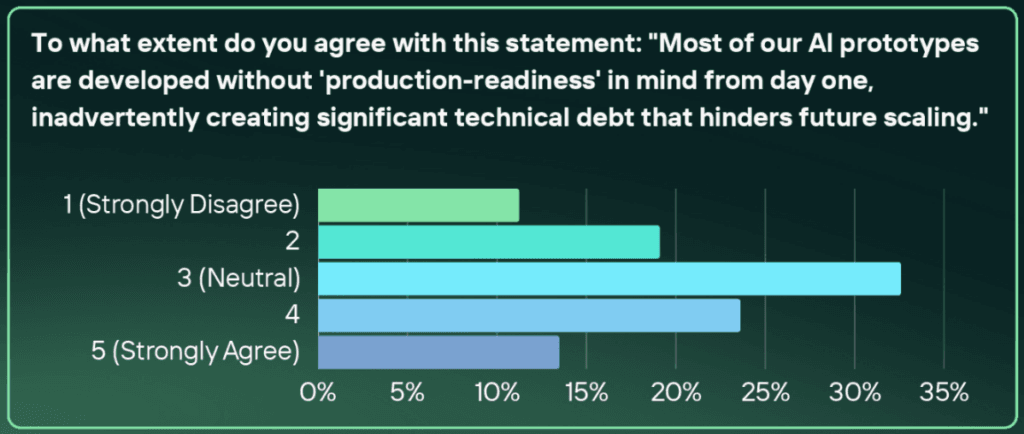
“The survey reveals 37% of organisations develop AI prototypes without production-readiness in mind. While teams should avoid over-engineering at the experiment phase because there’s a chance the project might be thrown away, be prepared for what you’ll need to take it to production if successful: secure data access, lifecycle maintenance (development, deployment, monitoring, making updates), regulatory compliance, and integration with other systems.
“Too many organisations reach PoC success only to realise they haven’t planned for any of this, which explains why two-thirds struggle to reach production.”

Mike Mead, Chief Product & Technology Officer
The Scale Factory
The three barriers to scaling AI
Our report identifies three primary hurdles that keep organisations trapped in Pilot Purgatory:
1. The organisational wall
The most significant non-technical barrier is a lack of alignment. We found that 59% of organisations rate the collaboration between Data Science, Engineering, and Business teams as neutral or ineffective.
This siloed approach is fatal for scaling. Data scientists might build a model that optimises for accuracy, while engineers need a system that optimises for latency and throughput, and business leaders demand a solution that optimises for ROI. Without a shared language and unified goals from day one, these teams pull in different directions.
2. The MLOps maturity gap
We cannot run modern AI on legacy processes. Yet, 74% of organisations are stuck in the early stages of MLOps maturity, relying on manual or only partially automated processes for deployment and monitoring.
This is a solvable problem. We solved it a decade ago with DevOps. The principles of automation, standardisation, and continuous integration that revolutionised software delivery must now be applied to AI. Without robust MLOps infrastructure, your team is effectively building the factory by hand every time they want to launch a new product.
3. The data foundation cracks
“It’s a data problem, not a model problem.” This adage holds true. A lack of advanced data management and governance is cited as a top technical hurdle. AI demands clean, accessible, and compliant data. If your data strategy is fragmented or your governance is weak, scaling AI becomes a liability rather than an asset.
Bridging the gap: A strategic roadmap
Moving from pilot to production requires a fundamental shift in mindset. Here is how visionary leaders can architect for reality:
Treat AI as a product, not a project
Shift the narrative from technical metrics to business value immediately. A model with 95% accuracy that sits in a sandbox offers zero value. A model with 75% accuracy that is integrated, reliable, and automating a core business process is infinitely more valuable.
Ensure every initiative has a dedicated product owner and a clear roadmap for integration, maintenance, and lifecycle management.
Invest in talent
There is a critical distinction between those who create the recipe (Data Scientists) and those who keep the kitchen running (MLOps Engineers). You cannot scale without the latter.
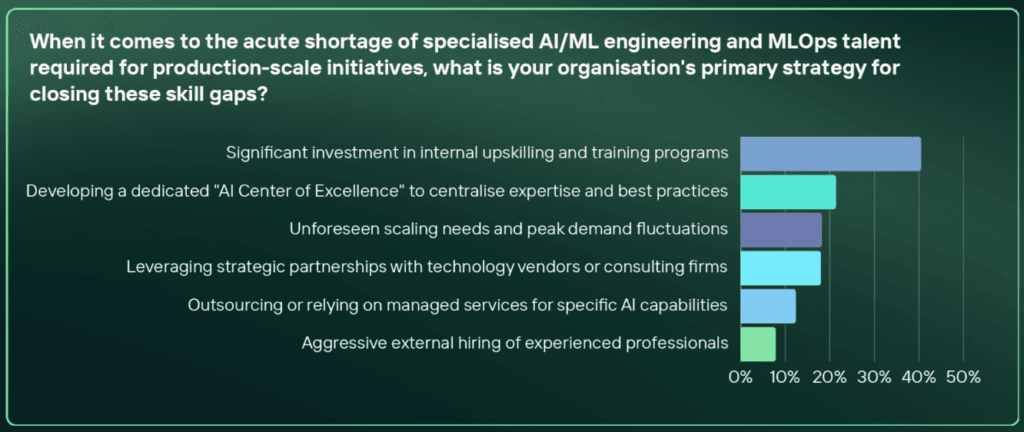
Our report highlights that while many organisations are investing in internal upskilling, the lack of mature internal pipelines limits the effectiveness of this training. Partnering with experts to build your “AI Centre of Excellence” can accelerate this capability, blending external expertise with your internal domain knowledge.
Solve the data problem first
Do not let the allure of the model distract you from the necessity of the foundation. Focus engineering efforts on creating clean, accessible data APIs that serve the entire organisation. Solving your data problem delivers value far beyond AI. It improves business intelligence, compliance, and decision-making across the board.
The path forward
The ‘ease’ of building AI prototypes today is both a blessing and a curse. It lowers the barrier to entry but masks the complexity of scaling.
To escape Pilot Purgatory, we must stop treating AI as a series of isolated experiments and start treating it as a core business capability. This means prioritising MLOps infrastructure over model tweaking, valuing uptime over pure accuracy, and fostering deep collaboration between your technical and business teams.
The gap is bridgeable. But it requires us to stop looking at the shiny object in the sandbox and start building the solid infrastructure needed to support it in the real world.